What I read in 2025

In 2025, I read more books than in 2024. Here are a few that I enjoyed most or learned most from.
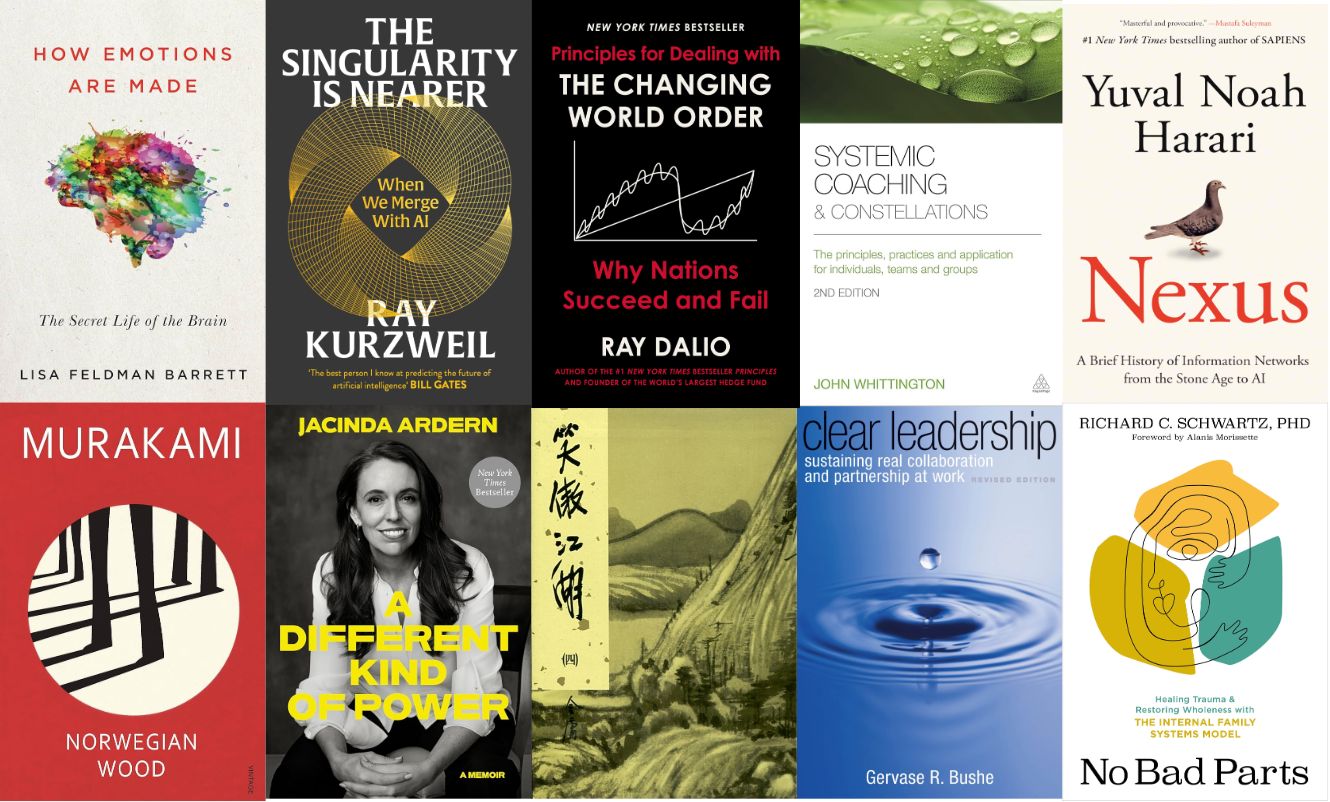
Here is my one-line takeaway, thought or reflection of each of those books.
- “How Emotions are Made” by Lisa Feldman Barrett - My brain constructs the emotions I should feel based on its best guess of what my body needs.
- “The Singularity is Nearer When we Merge with AI” by Ray Kurzweil - Information explosion is inevitable (Stanley: But that still won’t satisfy us if we don’t already know how to feel satisfied).
- “Changing World Order” by Ray Dalio - Empires rise and fall in predictable cycles, and we’re currently living in one cycle.
- “Systemic Coaching and Constellations” by John Whittington - People and things make sense when I see them in the context of the systems they belong to.
- “Nexus” by Yuval Harari - We created information networks to cooperate, and then they started controlling us.
- “Norwegian Wood” by Haruki Murakami - Grief and loneliness don’t resolve, they become a part of you that keeps lingering.
- “A Different Kind of Power” by Jacinda Ardern - Empathy isn’t weakness, it’s a different kind of power (and a potentially very powerful one).
- “Clear leadership” by Gervase Bushe - Clarity is merciful.
- “笑傲江湖” by 金庸 - Power corrupts, and lust for power corrupts absolutely.
- “No Bad Parts” by Richard Schwartz - What if every broken part of me is just trying to protect something precious?
Taking a step back, a broader theme that seems to emerge from many of those reads: There is always knowledge and understanding, and consciousness and being, that is far larger than the one we experience.
Whether they were books in neuroscience, history, fiction, coaching or politics, each one that resonated with me was essentially telling me, “The frame you are using is too small”.
- Barrett says my emotions aren’t what I think they are.
- Dalio says my lifetime is not the most important timescale to understand the world.
- Harari zooms out even more, to look at information flows across millenia.
- Whittington and Schwartz both say I cannot understand people without the context of the larger system and the arc of individual and collective histories.
- Even 金庸 says the people you trust most and who literally saved your life and made you who you were, can quietly backstab you.
Realising all of this feels really humbling. But that’s also the point (and magic) of reading - so that we may learn, make new meaning and grow. And to lead to the quiet question of “OK, now that I know all this what is my next wise action?”
This is what it means for me next. Given the work that I do (organisation development and people development), I would love to help more others to likewise experience this: To realise that the challenges and missed opportunities we face are often the result of us operating within a small and tight frame. That knowing and seeing more, and then grappling with the struggles as the frame expands, is the pathway to our growth.
But, as we grow out of our small and tight frames, we will bump up against more and more frames - each one bigger but ultimately still too small, tight and limiting. We will encounter more constraints, harder challenges and bigger opportunities.
For me, this gets close to what I think is the essence and purpose of life. I am reminded of this lovely quote by the poet Rainer Maria Rilke.
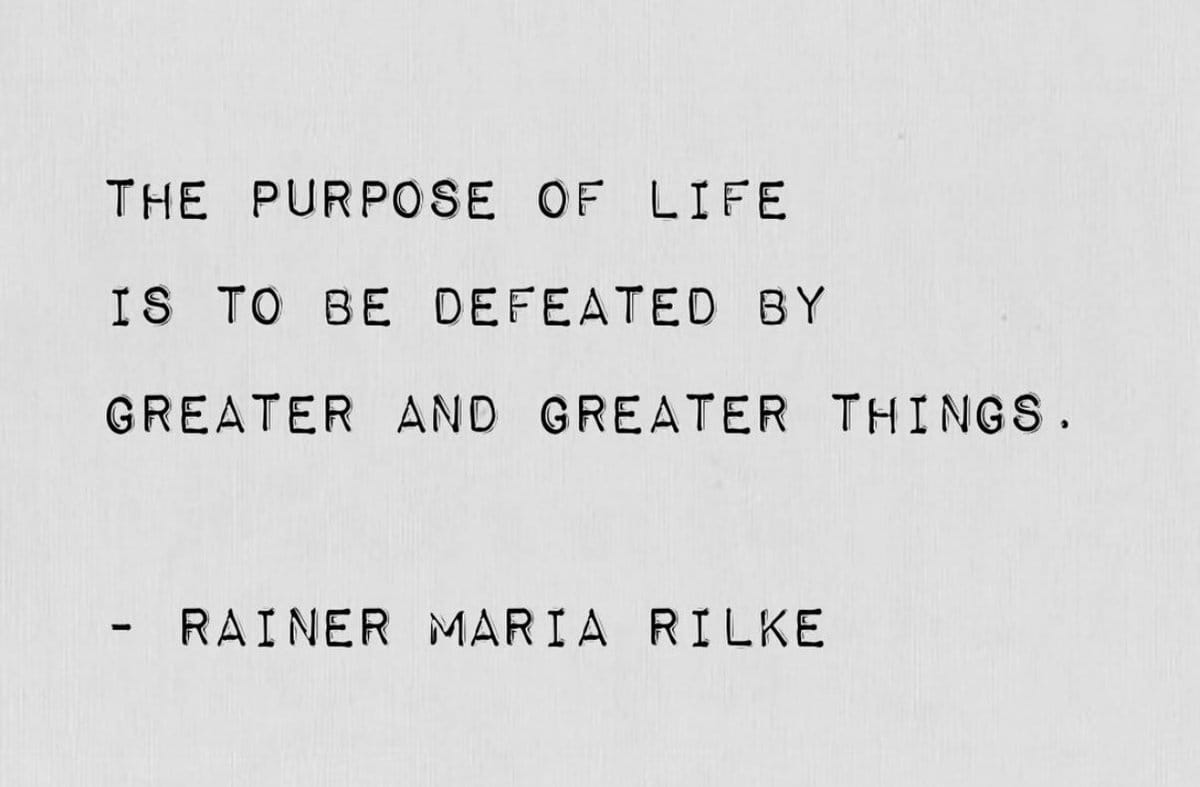
I find this very apt, especially in context to Kurzweil’s book. So much of the world today is seized in attention to how technology and AI is lurching forward, so fast that it feels like the Great Acceleration or the Big Explosion. But, why not a similar explosion in human consciousness, human ability and the human condition? And it's not so much a human condition augmented by AI, but rather the discovery and unlocking of the human condition in and of itself. I choose to believe this parallel track of progress alongside technological/AI progress is possible and it is worth seeking. I want to carry this aspiration and endeavour into 2026 and beyond.